

Portal hypertension is the core pathological link in the progression of advanced chronic liver disease (ACLD) and the key driver of various complications of cirrhosis. As the most authoritative programmatic consensus in the global field of portal hypertension, the Baveno consensus series has been updated every 5 years since 1990, continuously promoting the transformation of diagnosis and treatment from "complication treatment" to "risk stratification and prevention first". In March 2026, Baveno VIII – Advancing Consensus in Portal Hypertension was officially released. Co-developed by the European Association for the Study of the Liver (EASL) and multiple academic institutions, it formulates 272 strong consensus recommendations across 9 core areas, comprehensively updating the full-process diagnosis and treatment specifications for ACLD, portal hypertension and vascular liver diseases.
—————————— Key Highlights ————————
1. Comprehensive Innovation of Non-invasive Risk Stratification System with Optimized Diagnostic Criteria for CSPH
The consensus reaffirms the core prognostic value of clinically significant portal hypertension (CSPH), comprehensively strengthens the first-line status of non-invasive detection, and updates multiple key cut-off values and diagnostic models:
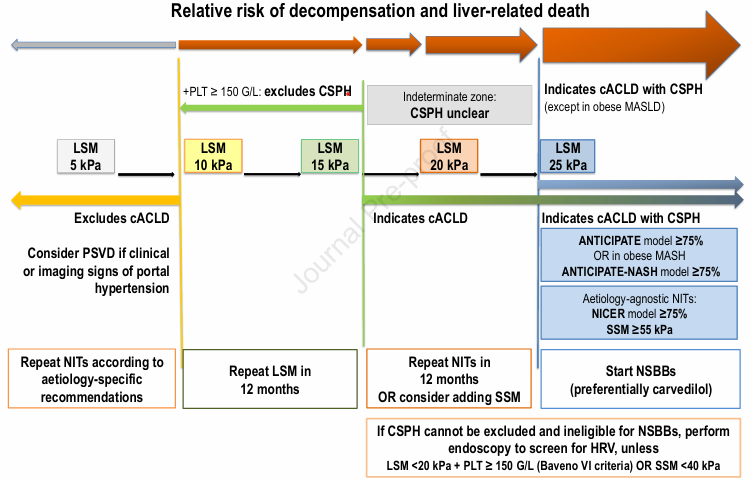
Ø Establishes the "5 kPa step rule" for liver stiffness measurement (LSM): each 5 kPa increase (LSM 10-15-20-25 kPa) corresponds to a stepwise increase in the relative risk of decompensation and liver-related mortality (LoE 2). In the absence of other clinical/imaging signs of portal hypertension, LSM < 10 kPa can rule out compensated ACLD (cACLD), while LSM > 15 kPa is highly suggestive of cACLD (LoE 3, SoR: strong).
Ø Constructs a non-invasive diagnostic system for CSPH: recommends the ANTICIPATE series models (LoE 1, SoR: strong) and NICER model (LoE 2, SoR: strong) as core assessment tools. CSPH can be excluded when LSM ≤ 15 kPa and platelet count (PLT) ≥ 150×10⁹/L (LoE 1, SoR: strong). CSPH can be diagnosed under the following conditions: ANTICIPATE probability ≥ 75% (LoE 1, SoR: strong); LSM ≥ 25 kPa in patients with viral/alcohol-related cACLD and non-obese (BMI < 30 kg/m²) MASLD-related cACLD (LoE 1, SoR: strong); spleen stiffness measurement (SSM) > 55 kPa (LoE 2, SoR: strong).
Ø Optimizes screening pathways: non-invasive CSPH-related tests should be repeated every 12 months (LoE 3, SoR: strong). For cACLD patients with contraindications or intolerance to non-selective beta-blockers (NSBB), endoscopic screening can be waived if LSM < 20 kPa and PLT ≥ 150×10⁹/L, or SSM < 40 kPa (LoE 1, SoR: strong).
Ø Adds recommendations for special populations: clarifies non-invasive exclusion criteria for CSPH in patients with BCLC stage 0–C hepatocellular carcinoma (LoE 3, SoR: weak); includes recommendations on risk stratification for pediatric portal hypertension for the first time (LoE 3, SoR: strong).
2. Refined Full-cycle Management of Decompensation with Upgraded Prevention and Treatment Strategies
The consensus reorganizes the definition and grading of decompensation and constructs a full-cycle management system of "first decompensation – further decompensation":
Ø Updated definition of decompensation: first decompensation is defined by core events including overt ascites, variceal bleeding and overt hepatic encephalopathy (LoE 2). Further decompensation (FD) has refined diagnostic criteria based on the type of initial event, corresponding to higher mortality risk (LoE 2).
Ø Precision in primary prevention: for cACLD patients with CSPH, carvedilol/NSBB is recommended to prevent decompensation (LoE 2, SoR: strong); prophylactic NSBB is not recommended for patients without CSPH (LoE 2, SoR: strong). Prophylactic transjugular intrahepatic portosystemic shunt (TIPS) may be considered before major surgery to reduce the risk of postoperative decompensation (LoE 4, SoR: weak).
Ø Standardized management of acute bleeding: establishes the standardized workflow of "restrictive transfusion – prophylactic antibiotics – emergency endoscopy – preemptive TIPS". The target hemoglobin for restrictive transfusion is 7–8 g/dL (LoE 2, SoR: strong); prophylactic antibiotic therapy is recommended for bleeding patients (LoE 1, SoR: strong); emergency endoscopy should be performed within 12 hours in hemodynamically stable patients (LoE 2, SoR: strong). The indications for preemptive TIPS (p-TIPS) are refined, with priority recommendation within the 72-hour window (LoE 1, SoR: strong).
Ø Rescue therapy for bleeding: covered self-expanding metal stent is the first choice as bridging therapy for refractory bleeding (LoE 4, SoR: strong); salvage TIPS is the first-line rescue option for bleeding that fails to respond to combined drug and endoscopic therapy (LoE 2, SoR: strong).
Ø Comprehensive management of further decompensation: TIPS is the first-line treatment for recurrent/refractory ascites (LoE 1, SoR: strong), and a stepwise dilation strategy with small-diameter stents can be adopted (LoE 3, SoR: strong). Portosystemic shunt embolization may be considered for refractory hepatic encephalopathy (LoE 3, SoR: strong). For patients with hepatorenal syndrome-acute kidney injury (HRS-AKI), terlipressin combined with albumin may be considered (LoE 1, SoR: strong).
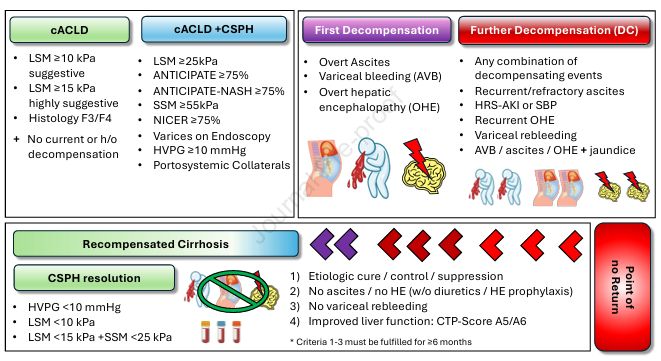
Figure 1 Schematic diagram of cirrhosis disease stage classification and diagnostic criteria for recompensation (Baveno VIII version)
3. Standardized Diagnostic System for Cirrhotic Recompensation Established for the First Time
This consensus systematically clarifies the definition, diagnostic criteria and assessment pathway of cirrhotic recompensation, filling the gap in this field:
Ø Core diagnostic criteria: the first three criteria must be continuously met for > 6 months (LoE 4): ① Elimination/control of the main etiology of cirrhosis (LoE 2); ② Resolution of ascites with discontinuation of diuretics, and absence of overt hepatic encephalopathy with discontinuation of related medications (LoE 2); ③ No variceal rebleeding (LoE 2); ④ Liver function improved to Child-Pugh grade A5/A6 (LoE 2).
Ø Etiology-specific criteria: clarifies the definition of etiology control for alcoholic liver disease (ALD, sustained abstinence), HBV infection (sustained viral suppression) and HCV infection (sustained virological response) (LoE 1).
Ø Assessment of CSPH resolution: patients with recompensation can undergo non-invasive assessment of CSPH status via LSM/SSM (LoE 2–4, SoR: weak); NSBB can only be considered for discontinuation after CSPH resolution is confirmed (LoE 3, SoR: weak).
Ø Follow-up requirements: patients with recompensation still require specialist liver follow-up every 6 months (LoE 3, SoR: strong) and continuous hepatocellular carcinoma surveillance (LoE 2, SoR: strong).
4. Comprehensive Improvement of Diagnosis and Treatment Standards for Vascular Liver Diseases
The consensus comprehensively updates the diagnosis and treatment pathways for three types of vascular liver diseases: Budd-Chiari syndrome (BCS), porto-sinusoidal vascular disease/non-cirrhotic portal fibrosis (PSVD/NCPF) and portal vein thrombosis (PVT):
Ø Budd-Chiari syndrome: establishes the stepwise treatment strategy of "anticoagulation – interventional recanalization – TIPS – liver transplantation" (LoE 2, SoR: strong); long-term anticoagulation should be initiated as soon as possible after diagnosis (LoE 2, SoR: strong); clarifies the differential diagnosis and monitoring pathway for hepatic nodules (LoE 3, SoR: strong).
Ø PSVD/NCPF: adopts a unified nomenclature across multiple societies and establishes a scoring diagnostic system integrating clinical, pathological and comorbidity data (LoE 5, SoR: strong); endoscopic screening can be waived if SSM < 40 kPa and bilirubin is normal (LoE 3, SoR: strong).
Ø Portal vein thrombosis: refines anticoagulation indications, treatment duration and drug selection for non-cirrhotic and cirrhotic populations. Therapeutic-dose anticoagulation should be initiated immediately after diagnosis of recent PVT (LoE 2, SoR: strong); anticoagulation is recommended for liver transplant candidates to ensure surgical feasibility (LoE 3, SoR: strong); TIPS may be considered for thrombosis complicated by portal hypertension complications (LoE 3, SoR: strong).
Ø Includes diagnosis and treatment recommendations for pediatric PVT for the first time, and clarifies that Meso-Rex bypass is the first-choice prevention and treatment for chronic PVT in children (LoE 3, SoR: strong).
—————————— Summary ————————
The Baveno VIII consensus represents another milestone update in the field of portal hypertension, comprehensively driving the shift of the diagnosis and treatment paradigm from "invasive assessment-dominated" to "non-invasive stratification-led", and extending from "passive treatment of complications" to "active full-cycle prevention". For the first time, the consensus establishes a standardized definition of cirrhotic recompensation and improves the diagnosis and treatment system for vascular liver diseases and pediatric populations, providing clinicians worldwide with more precise and operable diagnostic and therapeutic evidence.
Non-invasive detection technology centered on vibration-controlled transient elastography is the core assessment tool emphasized and strengthened in this consensus. Based on advanced vibration-controlled transient elastography technology, Hisky iLivTouch® series products deliver accurate, rapid and non-invasive quantitative measurement of liver stiffness (LSM). They cover the full disease course management scenarios highlighted in the Baveno VIII consensus, including cACLD screening and exclusion (LSM < 10 kPa), CSPH risk assessment (CSPH excluded with LSM ≤ 15 kPa + PLT ≥ 150×10⁹/L), decompensation risk stratification (5 kPa step rule for LSM), treatment monitoring and recompensation assessment (dynamic LSM follow-up), providing reliable support for clinical precise risk stratification and individualized diagnosis and treatment decisions.
Let every stiffness measurement become a key node in the precise management of portal hypertension.
Reference
Berzigotti A, Mandorfer M, Pons M, et al. Baveno VIII – Advancing Consensus in Portal Hypertension. J Hepatol. 2026. doi:10.1016/j.jhep.2026.07.030