

The Asian Pacific Association for the Study of the Liver (APASL) 2026 Congress highlighted new advances in non-invasive liver assessment across a range of clinical settings. At this year's meeting, iLivTouch-related research spanned both oral and poster presentations, reflecting growing interest in practical fibrosis assessment pathways, validation of guideline-based thresholds, and integrated non-invasive solutions for steatohepatitis and fibrosis evaluation.
In addition to the accepted abstracts, Professor Jinjun Chen shared his topic, “Spleen Stiffness for Portal Hypertension in Chronic Liver Disease,” during the congress. In his presentation, he discussed (expressed) the potential of combining iLivTouch liver stiffness measurement with spleen-related parameters as a new non-invasive testing strategy to help avoid unnecessary endoscopic diagnosis and grading procedures, further highlighting the clinical value of iLivTouch in portal hypertension assessment.
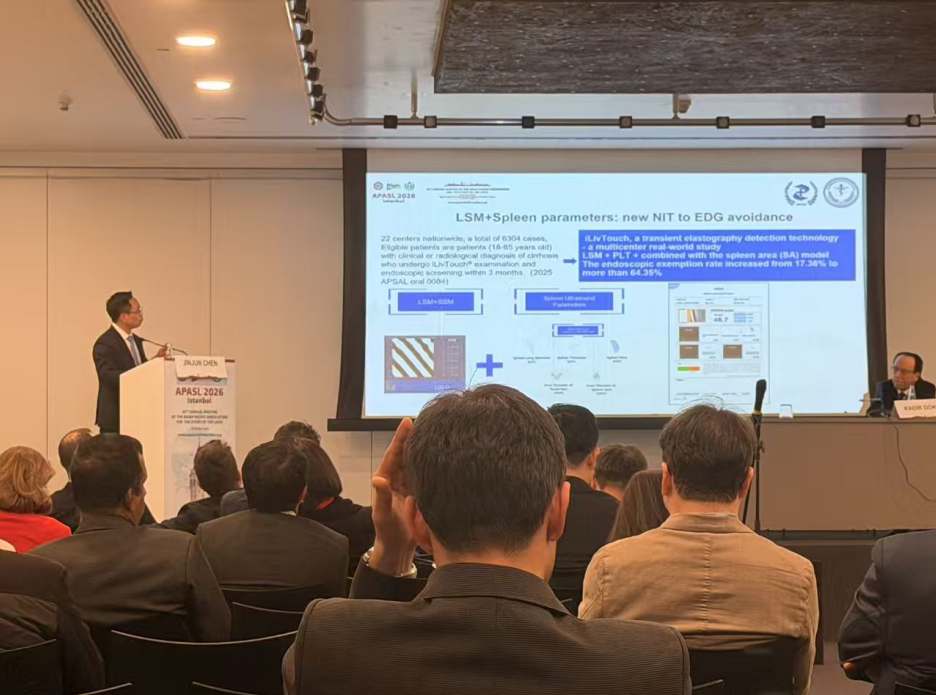
Professor Jinjun Chen shared insights on spleen stiffness and portal hypertension in chronic liver disease.
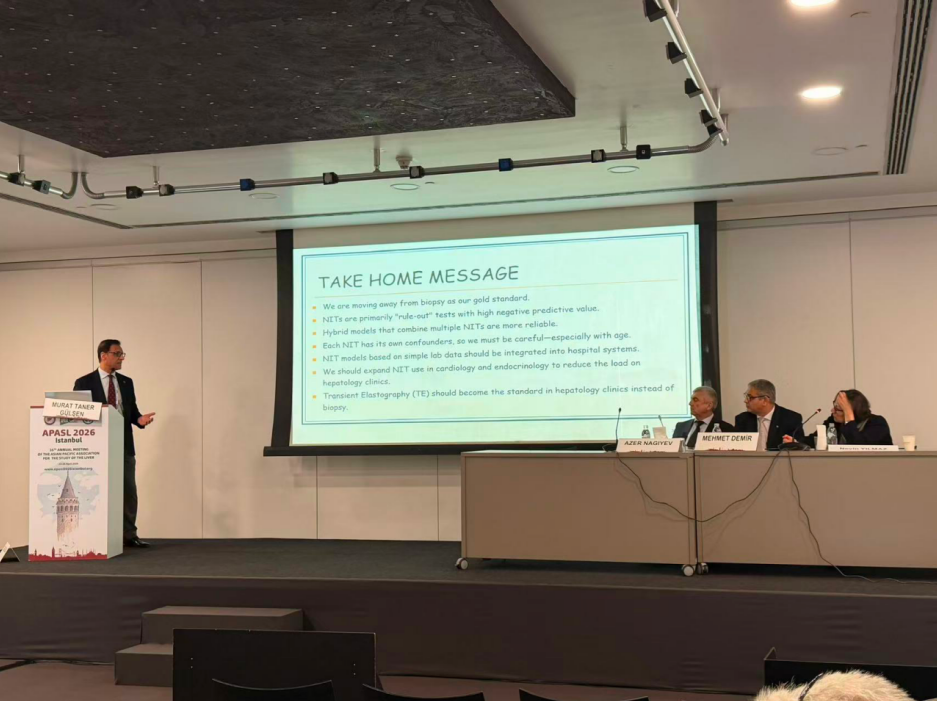
Dr. Murat Taner Gülşen contributed to the oral session on factors affecting measurement quality in liver elastography.
Current highlights include:
Oral Presentations
Oral 2559
Evaluation of a FIB-4-Based Clinical Pathway for Fibrosis Assessment in Patients with Coronary Heart Disease
Mengge Zhou1, PhD; Chenlu Yang2, PhD; Zehao Zhao3, MD; Yong Zeng3, MD
1 Department of Epidemiology and Biostatistics, Institute of Basic Medical Sciences & School of Basic Medicine, Chinese Academy of Medical Sciences & Peking Union Medical College
2 Vanke School of Public Health, Tsinghua University
3 Department of Cardiology, Beijing Anzhen Hospital, Capital Medical University
This study evaluated a stepwise fibrosis assessment pathway in patients with coronary heart disease, using FIB-4 as the first-line screening tool followed by iLivTouch. The findings showed that while the FIB-4-based pathway effectively stratified fibrosis risk in most patients, a meaningful proportion of individuals classified as low risk by FIB-4 were reclassified as intermediate or high risk by vibration-controlled transient elastography.Older age and obesity were associated with this discordance, suggesting that selective incorporation of iLivTouch may improve case detection in cardiovascular populations. These results support further refinement of non-invasive fibrosis screening strategies in patients with coronary heart disease.
Oral 2201
Prospective Evaluation of Factors Affecting Measurement Quality in Liver Elastography
Dr. Murat Taner Gülşen, Turkey
This prospective study evaluated factors influencing measurement quality in liver elastography with iLivTouch, including the effects of examination timing, repeated measurements, and correlations among key parameters. The findings showed good repeatability across consecutive measurements, with highly consistent results for LSM, UAP, and LivQ-box LIID, highlighting the strong stability and reproducibility of iLivTouch in routine practice. In addition, LivQ-box LIID was found to be associated with UAP while remaining independent of LSM, suggesting its potential relevance to MASH-related assessment.
Poster Presentations
Poster 2558
Diagnostic Performance of Baveno VII Criteria in a Real-World, Multicenter Cohort Across Liver Disease Etiologies
Yali Ji, Department of Infectious Diseases, Nanfang Hospital Affiliated to Southern Medical University,China
In a large multicenter cohort of 1,123 patients with diverse chronic liver diseases, iLivTouch demonstrated strong diagnostic performance for compensated advanced chronic liver disease, outperforming FIB-4 and APRI. The study showed that the optimal rule-out and rule-in thresholds derived from iLivTouch were highly consistent with the Baveno VII criteria of 10 kPa and 15 kPa. Importantly, performance remained stable across different liver disease etiologies, supporting the practical application of Baveno VII criteria with iLivTouch in real-world clinical settings.
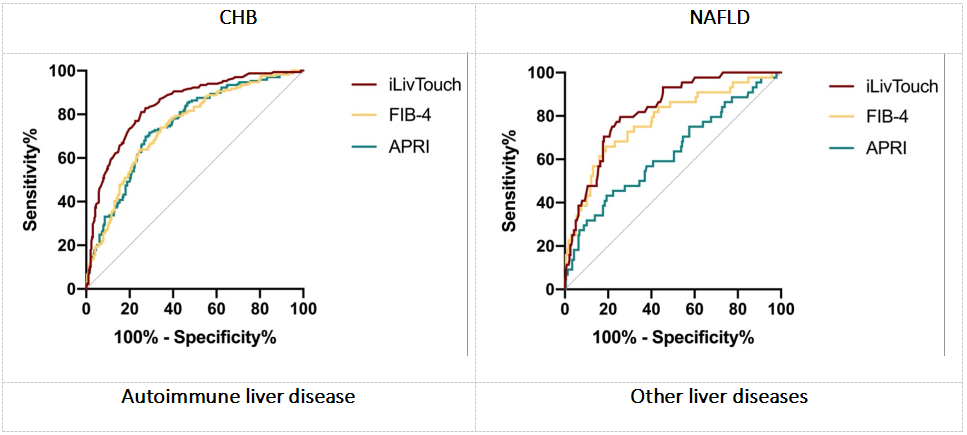
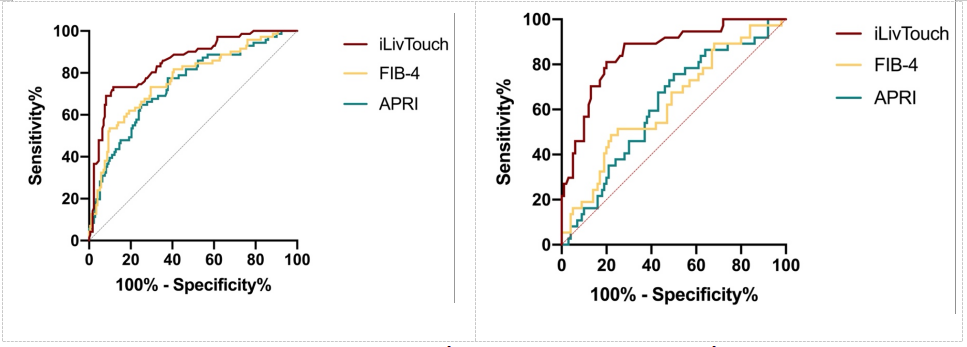
Figure 3. Receiver operating characteristic curves(ROC) of non-invasive evaluation methods for cACLD
Poster 2551
Detection of Metabolic Dysfunction-Associated Steatohepatitis and Fibrotic Burden Using Ultrasound-Derived LIID and Liver Stiffness Measurement in Metabolic Dysfunction-Associated Steatotic Liver Disease: A Multicenter Study
Feng Gao, MD,Department of Gastroenterology, the First Affiliated Hospital of Wenzhou Medical University, Wenzhou, China
This multicenter study explored a comprehensive non-invasive approach for MASLD assessment using the ultrasound-derived LIID score together with liver stiffness measurement from the iLivTouch platform. The LIID score showed promising performance for identifying MASH, while liver stiffness measurement delivered strong diagnostic value for fibrosis staging, especially for advanced fibrosis. By combining inflammation-related and fibrosis-related ultrasound markers on a single platform, the study highlights the potential of iLivTouch to support a more complete, biopsy-sparing evaluation strategy in patients with MASLD.
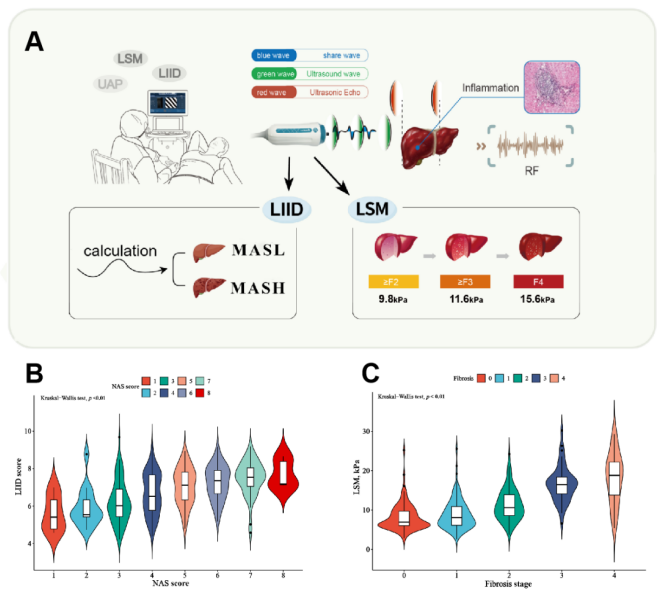
Figure 1A shows the radiofrequency data characteristics. Figure 1B illustrates the correlation between LIID score and NAS score. Figure 1C presents the correlation between LSM and fibrosis stage.
More exciting findings are yet to come as full results emerge. Stay tuned.