

Metabolic dysfunction-associated steatotic liver disease (MASLD) has become the most common chronic liver disease worldwide, and its risk of progressing to liver fibrosis, cirrhosis, and even hepatocellular carcinoma cannot be ignored. However, the lack of early screening methods means that most patients miss the optimal window for intervention. Insulin resistance (IR) and obesity are the core drivers of MASLD, and their synergy exacerbates disease progression. The triglyceride-glucose index (TyG index) is a commonly used indicator for assessing IR but does not incorporate obesity factors.
A team led by Professor Kun Ye and Professor Zhengming Li from the People's Hospital of Guangxi Zhuang Autonomous Region published a study titled "The relationship between triglyceride-glucose index, triglyceride-glucose-body mass index, and the severity of hepatic steatosis and liver fibrosis in patients with MASLD: a cross-sectional study" (Frontiers in Nutrition, IF=5.1). This study is a large-sample cross-sectional study that retrospectively collected data from 7,035 subjects who underwent iLivTouch testing at the People's Hospital of Guangxi Zhuang Autonomous Region from January 2019 to November 2023. All subjects underwent liver stiffness measurement (LSM) and ultrasound attenuation parameter (UAP) measurements using the iLivTouch transient elastography device, which were used to assess the risk of liver fibrosis and the degree of hepatic steatosis, respectively. Additionally, the predictive value of the TyG index and the TyG-BMI index for the severity of MASLD and liver fibrosis was compared, aiming to provide a better non-invasive screening strategy for clinical practice.
——————————Interpretation of Study Results————————
TyG and TyG-BMI indices increase with the severity of hepatic steatosis
After classifying MASLD patients into mild (n=1,233), moderate (n=1,511), and severe (n=841) groups based on UAP values (Figure 2):
Ø TyG index: mild 8.86±0.61→moderate 8.97±0.60→severe 9.19±0.67 (p<0.001);
Ø TyG-BMI index: mild 225.01±23.92→moderate 239.35±23.65→severe 270.41±37.15 (p<0.001).
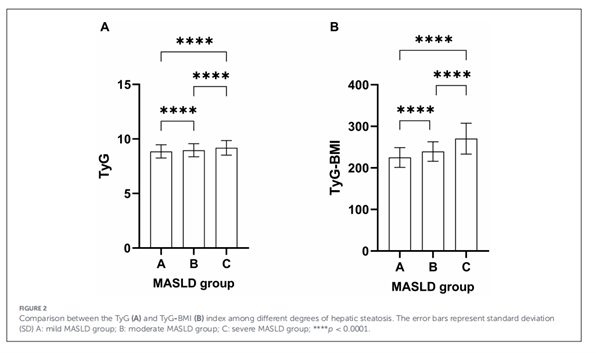
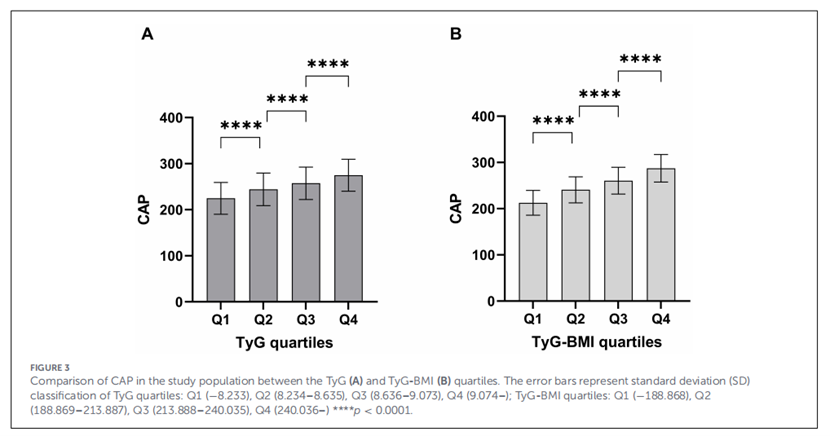
Figure 3 further shows that UAP values increased stepwise with rising quartiles of the TyG and TyG-BMI indices, both with statistical significance (p<0.001). Univariate correlation analysis (Figure 4) showed that UAP had the strongest correlation with TyG-BMI (highest R value).
TyG-BMI is an independent predictor of liver fibrosis
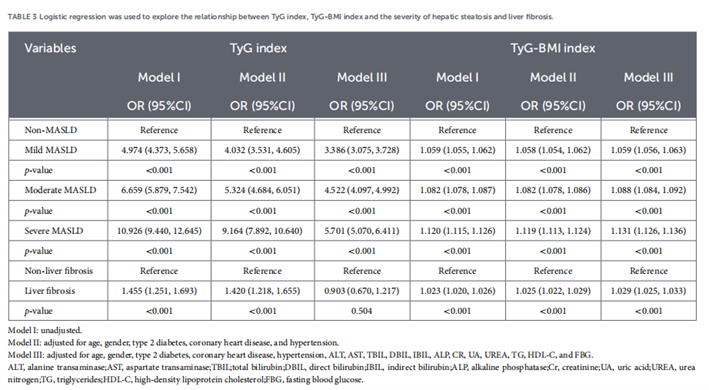
Among MASLD patients, comparing the liver fibrosis group (LSM ≥ 7.3 kPa, n=420) with the non-fibrosis group (n=3,165):
Ø TyG index: in the fully adjusted model (Model III), the TyG index was not significantly associated with liver fibrosis (OR=0.903, 95% CI: 0.670-1.217, p=0.504);
TyG-BMI index: in the fully adjusted model (Model III), each additional unit of the TyG-BMI index, the risk of liver fibrosis increased by 2.9% (OR=1.029, 95% CI: 1.025-1.033, p<0.001).
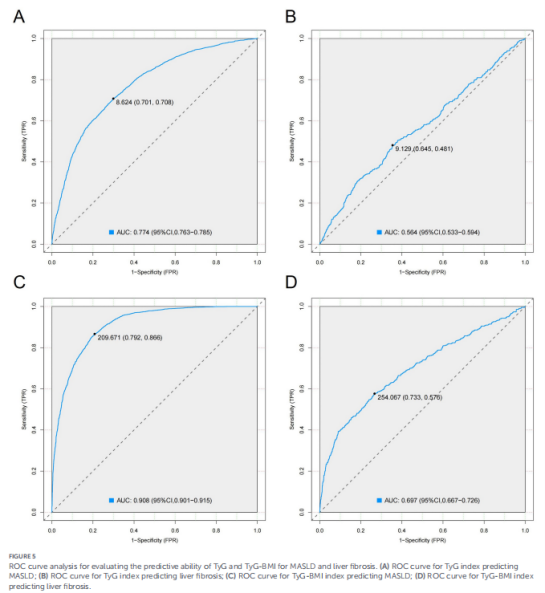
ROC Analysis: Predictive performance of TyG-BMI is significantly better than TyG
Based on ROC curve analysis for predicting MASLD (Figures 5A, 5C):
Ø TyG index: AUC=0.774 (95% CI: 0.763-0.785), sensitivity 70.8%, specificity 70.1%, optimal cut-off value 8.624.
Ø TyG-BMI index: AUC=0.908 (95% CI: 0.901-0.915), sensitivity 86.7%, specificity 79.2%, optimal cut-off value 209.671.
Based on ROC curve analysis for predicting liver fibrosis (Figures 5B, 5D):
Ø TyG index: AUC=0.564 (95% CI: 0.533-0.594).
Ø TyG-BMI index: AUC=0.697 (95% CI: 0.667-0.726), sensitivity 57.6%, specificity 73.3%, optimal cut-off value 254.067.
——————————Summary————————
This study based on the iLivTouch non-invasive liver fibrosis detection system, conducted a cross-sectional analysis of 7,035 subjects, systematically evaluating the predictive value of the TyG index and the TyG-BMI index for hepatic steatosis and liver fibrosis in MASLD. The results showed that the TyG-BMI index was significantly associated with the severity of MASLD and liver fibrosis, and its predictive performance (AUC=0.908) was significantly better than that of the traditional TyG index (AUC=0.774). The precise UAP and LSM data provided by iLivTouch offer a reliable non-invasive assessment foundation for the study. In the future, iLivTouch combined with the TyG-BMI index is expected to construct an efficient and economical MASLD stratification screening strategy, promoting the early identification and precise management of metabolic liver disease.
[1] Wu X, Mo J, Yu J, et al. The relationship between triglyceride-glucose index, triglyceride-glucose-body mass index, and the severity of hepatic steatosis and liver fibrosis in patients with MASLD: a cross-sectional study. Front Nutr. 2026;13:1740308. Published 2026 Feb 26. doi:10.3389/fnut.2026.1740308